 www.frogfish.ch

|
Eastern
Atlantic If not from the areas above |
Identification Key Frogfishes
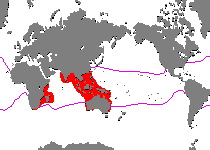
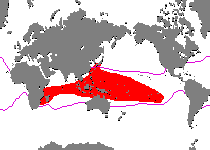
Tropical Australia - Striped Frogfishes
(Great Barrier Reef, Timor Sea, Gulf of Carpentaria, Ningaloo)
All frogfish species listed here are living in the tropical Australia
and are striped.
For frogfishes with no stripes living in
the tropical Australia click here.
For a overwiew of all frogfishes from this area click here.
1. Stripes on the whole body
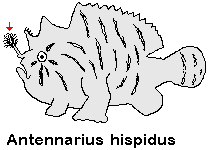
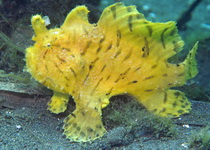
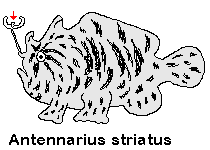
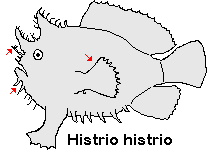
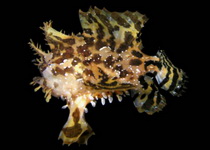
Antennarius hispidus differs from Antennarius striatus in the shape of the Esca (large oval-shaped tuft versus worm-like appendages). Both species differ from Histrio histrio that this frogfish-species has very large pelvic fins which it needs to float in the Sargassum weed.
Antennarius hispidus (Hispid frogfish - Hispid Anglerfisch)
 |
|
Information15-20cm
|
 |
|
|||


Antennarius striatus (Striped or hairy frogfish)
 |
|
Information18-22cm
|
 |
|
|||
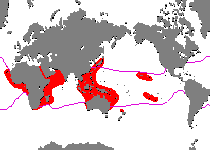


Histrio histrio (Sargassumfish)
 |
|
Information20cm
|
 |
|
|||


2. Only striped tail
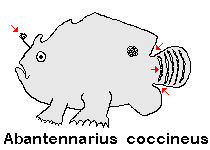
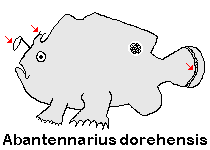
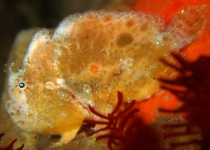
Abantennarius dorehensis and Abantennarius coccineus both belong to the genus Abantennarius (formerly Antennatus) and are difficult to distinguish from each other. Here some characteristics that might help with an identification:
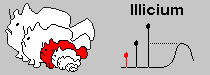
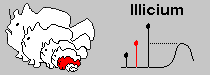
Abantennarius dorehensis - the esca on the lure points towards the belly
and is very small.
Abantennarius coccineus - Lacks distinct tail base (dorsal and anal fins
end at base of tail fin)
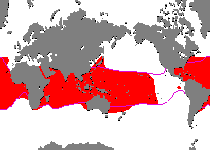
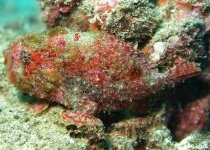
Abantennarius coccineus (Freckled frogfish)
 |
|
Information9-13cm
|
 |
|
|||



Abantennarius dorehensis (New Guinea Frogfish)
 |
|
Information2.5-5cm
|
 |
|
|||
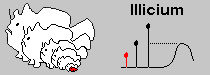


This identification key is only for species of the subfamily Antennariinae
(frogfishes, family Antennariidae, suborder Antennarioidei) which are
frogfishes living in tropical and Subtropical waters.
Please take note, that this is a simplified identification key. Ichthyologists
use tables with the number of dorsal, anal and pectoral rays, the length
of the illicium and other distinguishing characteristics for means of
identification.