 www.frogfish.ch

|
Eastern
Atlantic If not from the areas above |
Identification Key Frogfishes
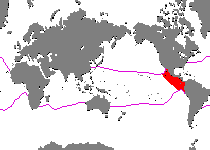
Eastern Pacific
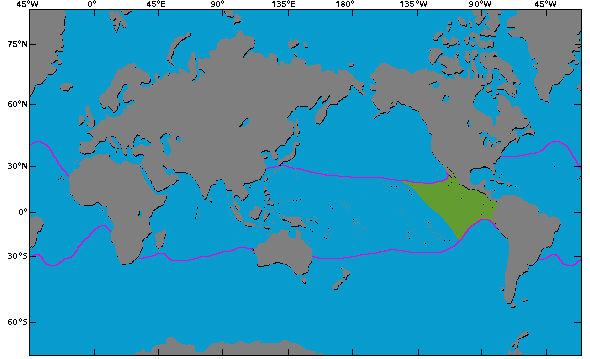
For a overwiew of all frogfishes from this area click here.
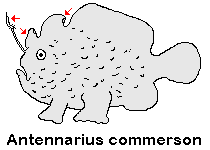
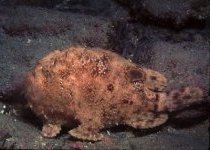
There are only 5 frogfish species found in the Eastern Pacific. Two of them are the largest species known - Fowlerichthys avalonis and Antennarius commerson. These two species differ in the large ocellus (eye spot) with a white margin that can be seen on the body of Fowlerichthys avalonis. Furthermore Antennarius commerson has a very long lure with a distinct bait. Please also look at the coloring.
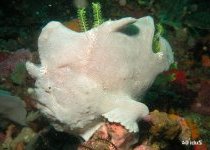
Antennarius commerson (Giant frogfish)
 |
|
Information30cm
|
 |
|
|||
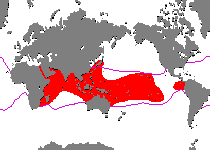



Fowlerichthys avalonis (Roughbar frogfish)
 |
|
Information33cm
|
 |
|
|||
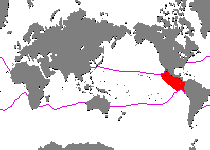



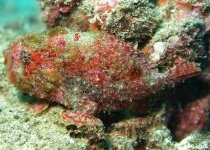
Abantennarius coccineus and Abantennarius sanguineus are related to each other and both belong to genus Abantennarius (formerly Antennatus). These two species can be distinguished by the shape of the bait (Esca of Abantennarius sanguineus with long filaments)
Abantennarius coccineus (Freckled frogfish)
 |
|
Information9-13cm
|
 |
|
|||



Abantennarius sanguineus (Sanguine frogfish)
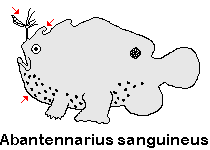 |
|
Information8cm
|
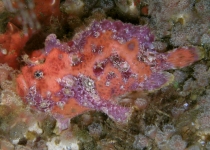 |
|
|||
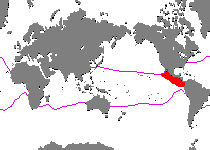

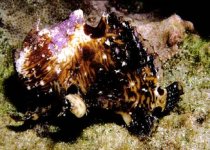
Antennatus strigatus hast a distinct coloring which is differnt to other frogfishes.
Antennatus strigatus (Bandtail frogfish)
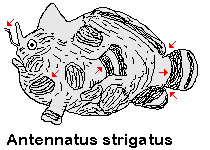 |
|
Information8cm
|
 |
|
|||



This identification key is only for species of the subfamily Antennariinae (frogfishes, family Antennariidae, suborder Antennarioidei) which are frogfishes living in tropical and Subtropical waters.
Please take note, that this is a simplified identification key. Ichthyologists use tables with the number of dorsal, anal and pectoral rays, the length of the illicium and other distinguishing characteristics for means of identification.